Showing posts with label beef. Show all posts

Saturday, November 1, 2025

Attelets Sauce - An American Civil War recipe

Do you know what an attelet is?  I didn't.  I had to look it up.  Autocorrect wanted to change the word to "athlete," but I insisted I had spelled it correctly.  That taught me that an attelet is a small, metal skewer, often decorative and made of precious metals such as gold or silver.  Attelets are used to hold food, often hors d'oeuvres, to display it elegantly.

So now you know.  An attelet is basically a small, decorative metal spit used to show off food in a fancy way.

An attelet.  Click here for attribution.

I was preparing for a Civil War reenactment and looking through the 1833 cookbook for recipes that I could make as a demonstration item.  That is, I was cooking over charcoal while wearing a period outfit and talking to the public about what I was making.  I needed to be able to fix it in front of the public, with the exception of when I walked into the tent to get items from the ice chest.

This sauce looked interesting and tasty.  I didn't have metal attelets, but hey, we were in a war setting, so wooden skewers would have to do!

My plan was to make the sauce to serve with thinly sliced, grilled beef on skewers.  I did that and then made the recipe again at home for this post.

The recipe is from Mrs. N.K.M. Lee's The Cook's Own Book, page 182, in the sauce section, which is why the "________" is in the title.  Click here to see an 1854 reprint of her book.  


My Redaction
1 to 2 tablespoons each of finely chopped parsley, mushrooms, and shallots
1 tablespoon butter
1 tablespoon flour
1 cup beef broth
1/4 teaspoon pepper
salt to taste
2 egg yolks, well beaten

1/2 pound thinly sliced beef

Sauce ingredients.
First, soak wooden skewers in water while preparing the sauce.  Cut the beef into 1-inch-wide strips and set aside.

Mix the mushrooms, shallots, and parsley and then sauté them in the butter over low heat until the shallots are translucent.  

Sprinkle the flour over the mixture (avoid lumps) and stir well.  Let it cook for 1 to 2 minutes.

Whisk in the broth, stirring it vigorously.

Bring the mixture to a boil, then reduce the heat to make the mixture simmer.  Add the pepper and salt to taste. 

When the mixture thickens slightly, remove from the heat.  Add the yolks by pouring them in while stirring the broth briskly.

Once the yolks are thoroughly mixed, put the sauce back on the heat while stirring well to slightly cook the yolks.

Put the beef strips on the skewers and grill the meat.

Serve the skewers on a plate and the sauce in an open cup or bowl.  Dunk the beef in the sauce to eat.

Roughly equal parts.

The finished sauce.
Grilling the meat.

My Notes

At the reenactment, I didn't have parsley.  I aimed for roughly equal parts of shallots and mushrooms.  In both attempts, I used baby portabella mushrooms.

The idea is to make a roux with the butter and flour, then use the roux to thicken the broth.  The egg yolks make it even thicker and richer.

The broth I used had salt in it, so salt your sauce to taste.

The Verdict

Oh my, that is one good sauce.  At the reenactment, I walked around with the platter of skewers and a cup of sauce.  People used their fingers to pull the meat off the skewer and dunk it into the sauce, then pop the meat into their mouths.  You could see the sauce was thick enough to stick to the meat and not drip all over when transported to a mouth.

It was similarly thick when I made the sauce at home.  

Note the thick sauce.

The flavor was rich with shallot and mushroom flavors, enhanced by the savory umami of the beef broth.  The pepper added a nice bitter flavor, too.

Everyone in both attempts enjoyed it.  I had sauce left over from the reenactment, so I served it as a gravy over mashed potatoes, which was quite excellent.  At home, I used the extra gravy as a sauce over baked chicken thighs; this was also good.

I think the reenactment version was a bit tastier; I probably used more shallots.  I wasn't measuring except by visually comparing quantities.  I am usually moving quickly, too.  

Success!  Quite a wonderful success, really.  Make this sauce as it is easy and tasty.  

I think I would use bigger chunks of beef instead.  The very thin slices grilled quickly (a bonus, so the sauce didn't get cold or get overcooked) but they did get chewy.  I probably need to improve my grilling skills.


Saturday, March 15, 2025

Fashionable Ox - a Beef Stew (Pinedo recipe)

I am continuing to try out some of Encarnación Pinedo's stews.  Today's is a beef stew, one that I would consider a "standard" European (really French, I think) style with an interesting historical direction. It is on page 39, and I love the name.


My Translation


My Redaction

2 1/2 pounds of beef

1/4 cup broth, any flavor

1/4 cup white wine

2 cans diced tomatoes (14.5 ounce cans)

1/2 pound ham, cubed (about 1/2-inch size)

8 ounces carrots

1/2 cup chives, chopped into 1/2-inch pieces

1 teaspoon pepper

1/2 teaspoon cardamom

1/4 teaspoon mace

1/4 teaspoon coriander

First cut the beef into cubes, about 1-inch on a side, roughly.  Place in a slow cooker, add the broth and the wine.

Cover and cook on low heat for 2 hours.

Cut the carrots into bite-sized pieces as needed. 

In a skillet, combine the tomatoes, ham, carrots, chives, and spices.  Bring to a slow simmer.  Cook about 30 minute or until carrots are tender, stirring occasionally.

Mix in the drained beef and serve.

Sauce before cooking

Sauce after cooking
Beef after cooking.  Just use the meat and discard the liquid.

My Notes

I had some pork broth in my refrigerator, so I used that with the meat.  

Pinedo specifies "especies finas", "fine spices", and this is the only recipe that calls for that mix.  I interpreted it as a medieval spice blend called "powder fines", which can contain any number of spices, such as pepper, cinnamon, cardamon, coriander, grains of paradise, ginger, nutmeg, and so on.  The basic idea is a savory (vs sweet) mixture even though it uses many spices I consider "sweet", as in "I expect to see them in cookies, cakes, etc."

In making my choices, I knew one of my guest tasters does not like cinnamon, so I avoided that.  Putting in two savory spices (pepper and coriander) and two sweet spices (mace and cardamom) seemed like a good combination without risking making the spice blend too strong and overwhelming the dish.

Notice that she didn't call for salt.  I believe that the ham is a good way to introduce salt into the stew.

I used small carrots, so I didn't cut them.  I wanted the look of the bright orange carrots as part of the stew.  

This was so simple to prepare.  I appreciated that because it was a busy few days and I could easily prepare all in advance.  In fact, after the meat and sauce were done, I cooled and stored them separately in the refrigerator overnight.  The day of the meal I reheated the sauce, added the meat, and let the whole stew slowly warm through on the stove.

There was no need to defat anything before reheating.  Most of that fat had been left behind when I took the meat out of the slow cooker.

The Verdict

I served it with shell macaroni on the side and a tossed green salad.  And wine!

Visually, the stew was appealing with its colors and shapes.

The meat was tender and everyone noticed that.  

The sauce was flavorful and the carrots were tender, too, but not mushy.  I really liked that.

The entire mixture was good with the meats, tomatoes, chives, and carrots all contributing to the taste experience.  I suggested that the spice blend was too strong and was quickly outvoted by the guest tasters.  No one wanted salt on it.

The stew was well-received.  When I had the leftovers the next day, I decided that spice mixture wasn't too strong, but I thought it was close to being so.  If this worries you, I would cut down on the pepper a little.  

Success!

The stew matches the tablecloth...


Wednesday, January 15, 2025

Estafado español - Spanish Stew, a Pinedo recipe

It is time for another Pinedo recipe!  If you are new to this blog, I'm cooking from Encarnación Pinedo's El cocinero español cookbook, published in 1898.  Her recipes show up on this blog and one dedicated just to her recipes, found here:  The Spanish Cook Without Equal.

Today I am making a stew for dinner, and I chose the one on pages 103 - 104.


My Translation


My Redaction

2 1/2 pounds boneless beef bottom round roast
olive oil for browning the meat
1 pound ham, cubed
1 pound pearl onions, stemmed and peeled
1 1/2 teaspoons chopped garlic
1 tablespoon fresh thyme leaves
1/4 cup fresh parsley, chopped after the stems are removed
1 bay leaf
1 teaspoon cinnamon
1 teaspoon pepper
1/4 teaspoon cloves
1 cup red wine (I used cabernet sauvingnon)
1/4 cup apple cider vinegar

I only used one piece of the beef.  That is what fit in the slow cooker.

Cut beef into eating-sized cubes, about 1 inch by 1 inch or a little smaller.
Heat oil in a skillet.  Add beef in batches, stirring often to get the pieces browned.
Put each batch into a slow cooker.
Add all the other ingredients in the slow cooker.
Mix well.
Cook on low for 4 to 5 hours.
Cool, refrigerate, and remove the solid fat.
Reheat to serve.

My Notes

I cut off a lot of the excess fat on the beef.  There wasn't much and I didn't try to get it all off, just the majority.  Then I cut the meat into cubes of a sort.

Pinedo didn't state to brown the meat, but I suspected that was the purpose.  Otherwise I didn't see a need for adding fat to the pan.  Browning does make for a better flavor and presentation.  Since I had so much meat to brown and you don't want to crowd the pieces in the skillet, I used two skillets at one time.  I didn't measure the oil used -- I just put in enough with each batch so that the meat wasn't sticking to the pan.  

Honestly, the most tedious part of making this dish was trimming and peeling all the tiny onions.  I chose pearl onions because Pinedo had specified whole onions.  That was the only way I could imagine having individual servings without someone getting stuck with a massive onion in their bowl or removing the onions before serving.  It helps to have a bowl to hold the peeled onions and another bowl to hold the trimmed ends and peels, while you work over a cutting board. Although now that I think of it, I've seen old recipes with one whole onion (regular size) that had cloves stuck in it.  If that was her intent, I didn't pick up on it.

Perhaps she did not intend for one entire pound of ham in this stew, but that is what I had so I used it all.  The cubes were smaller than those of the beef.  Notice there is no salt called for; I think adding ham is her way of getting salt into the stew.  (Or she just assumes we will add salt at the end, "to taste.")

She specified wine or vinegar.  I chose to use both because I like the flavor a red wine brings and the brightness an acid adds to a sauce.

A slow cooker is the closest thing we have to cooking slowly over hot coals.  It can really do a good job getting the flavors blended and having the meat turn out tender (without having to tend a fire).  My frustration is usually that I overcook the meat, which is never appealing to me.  So despite the slow cooker books advising to cook beef stews for 8 to 12 hours on low, I chose to go for 5 hours.  At this time, the beef was perfectly tender and not overcooked.  I could probably have stopped it at 4 hours, which is why I listed a range in the redaction.  Maybe my slow cooker cooks hotter than the average one?
The onions because I peeled each and every one!
Browning in small batches.

Everything but the liquids.  Stir to combine.

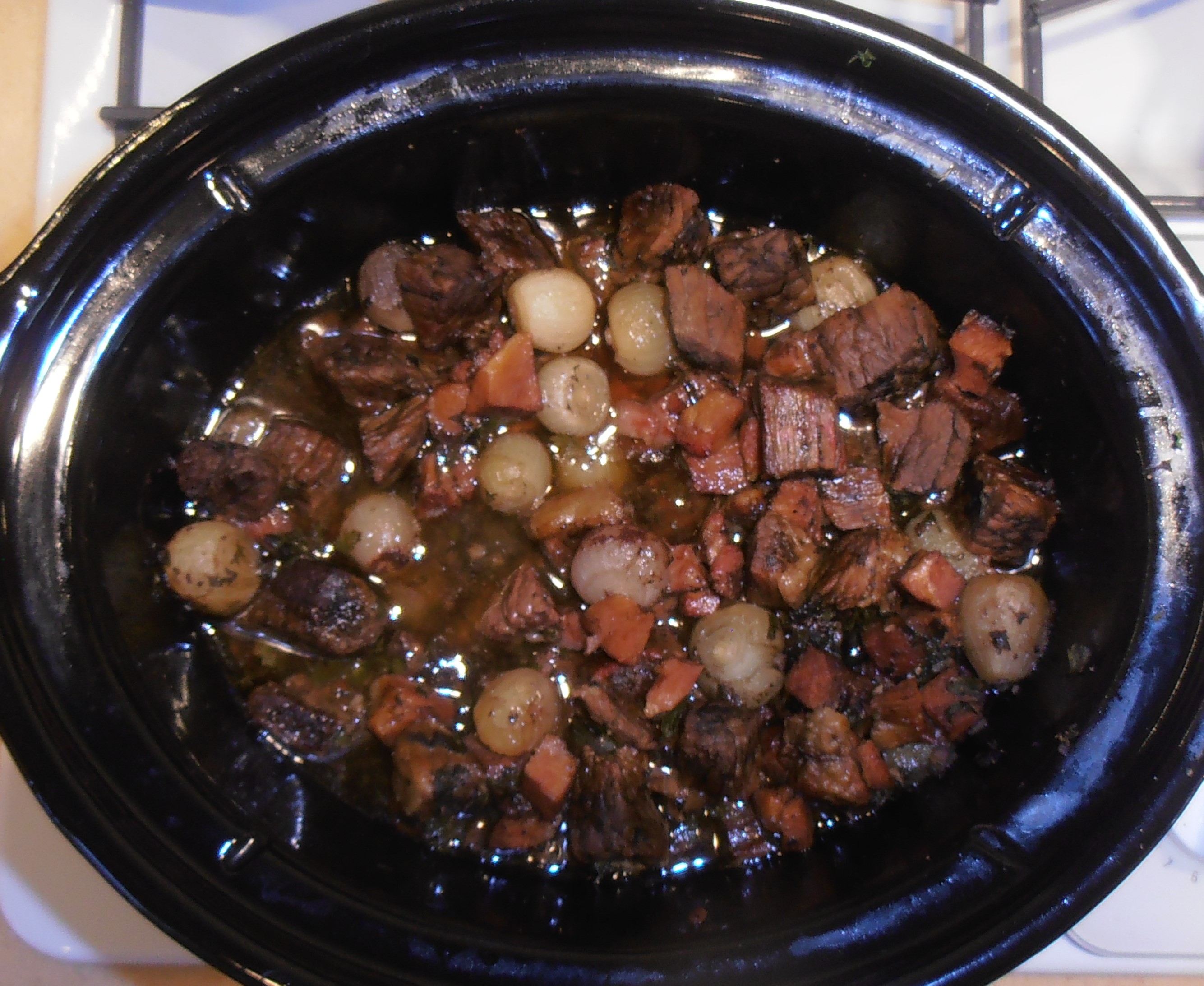
Cooked. The orange is the ham, though it looks like carrots.

The Verdict

I served the stew with cooked shell macaroni on the side, so people could put the pasta in their bowl and stew on top of or next to it. Pinedo has several recommendations in her book to serve stews with macaroni.


Other dishes in the meal were a sweet potato-apple souffle (see the recipe by clicking here) and a side salad with spring mix, chopped apples and persimmons, pecans, pomegranate arils, and goat cheese.  It was dressed with a pomegranate molasses-based vinaigrette.

The primary comment was "the beef is so tender!" and it was. For a simple stew that was basically beef, ham, and onions, it was tasty!  One guest taster who does not like cinnamon could taste it - it was not off-putting but not her favorite.  Those of us who like cinnamon loved the sauce flavors.  No one spice or herb dominated -- it was a good blend.  

My guest taster who loves beef thought was it very good and had seconds.  

Everyone wished the sauce was thick so it was more like a gravy that would stick to the pasta and meat instead of running to the bottom of the bowl.  

I liked the whole stew and the sauce flavor blend.  The texture was fine.  I think I would rather serve it over mashed potatoes if the sauce wasn't thickened.  When I had the leftovers, I thought I really liked having a lot of broth with the ingredients and no pasta, so it was more of a soupy-stew.  Then I got to taste more of the broth, which was a good thing.

Success!

Worthwhile doing it again as it is so easy to prepare and cook.  Making it in advance is a good idea because reheated stews are always better.


Friday, November 1, 2024

Salsa á la española -- Spanish Sauce, a Pinedo recipe

Today I opened Pinedo's book to a random page and picked a recipe from that page.  I was happy to find a main dish, and my guest taster was happy it involved beef.

On page 241, I chose Spanish Sauce for pieces or slices of beef.  

Pinedo's recipe


My Translation

Spanish sauce.

(For pieces or slices of beef.)

         After the meat slices are fried in the pan, they are removed and in that fat, which must be very little, two chopped onions will be fried, leaving them to brown. To these, three tomatoes and as many finely chopped green chiles, garlic, a tablespoon of butter, oregano, pepper and salt are added. The sauce is allowed to cook over a low heat to make it juicy.

         Place the meat slices in the serving dish, covering them with the sauce and surrounding it with fried potatoes.

My Redaction

1.6 pounds thinly sliced beef steak
2 onions, medium sized
3 tomatoes
3 jalapeño chiles
1 tablespoon fresh oregano
1 tablespoon butter
2 teaspoons chopped garlic
1/2 teaspoon salt
1/2 teaspoon pepper


Heat a fry pan to medium heat and fry the steaks for 2 minutes or less on one side, 1 minute or less on the other.  Adjust timing to suit the thickness of the steak.  Add a little olive oil to the pan as needed if the steaks are very lean.

Set the cooked steaks aside into the serving dish.  Arrange them nicely on the dish but don't overlap them too much.  

Peel, core, and chop the onions while the beef is cooking.  Once the steaks are done, brown the onions in the remaining fat.  Add a little olive oil if necessary.  Medium heat is fine and stir them occasionally.

While the onions are cooking, remove the stem ends of the tomatoes then chop them.  Remove the stem, seeds, and veins of the jalapeños, then finely chop them.  Strip the oregano leaves from the stems and chop them finely.

Once the onions are browned, add the tomatoes, chiles, oregano, garlic, butter, salt, and pepper.  Mix them well and turn the heat to low (2 or 3 out of 10).  Let the sauce simmer.  Cook until all the vegetables are soft and the flavors are melded; for me that was 15 to 20 minutes.

Spoon the hot sauce over the top of the meat, until the surfaces are completely covered.  If desired, place fried potatoes around the meat.  Serve immediately.

My Notes

Some of my steaks were very thin and cooked quickly.  I cooked one at a time.

I was being careful not to make the dish too spicy chile hot, so I made sure the seeds and veins were removed.  

I added the rest of the ingredients when the onions were somewhat cooked and a little brown.  Perhaps I should have taken them to carmelized.

My choice of fried potatoes was not available to Señorita Pinedo:  I baked frozen french fries in my oven.  

I arranged them better after this picture.  
I called this browned.
To give you a feel for their relative sizes.
All ingredients in the pan.
Well-mixed and starting to cook.
Done!
The Verdict

The sauce wasn't particularly "juicy" but it was very moist, which I liked.  The sauce was not runny.

I spooned most of it over the top of the steaks, which were cool but the sauce was hot enough to warm them back up again.  The steaks were completely hidden from view.

Then I placed the fried potatoes on the sides of the platter, where they would fit.  I noticed they started soaking up the released juices from the steaks.

A delightful presentation!

It was easy to pick up a piece of steak with sauce piled on it using a wide serving fork.  I successfully transfered each piece to a plate.  Then I used the fork to put potatoes on the plate.  That was dinner, along with some cabernet wine.

And wine!
The combination of sauce with beef was good!  Each bite was meaty with the tender vegetables' flavors included.  It was not a robust sauce -- not strongly flavored.  But I enjoyed the onions, tomatoes, and the unique flavor the chiles added.  In a way, I am glad the sauce did not dominate the meat as I wanted to taste both.  Overall, a very pleasant main dish.

I kept getting a "ratatouille" vibe from the sauce, but with chiles instead of squash.  I liked it and so did my guest taster.  We both felt the pepper quantity was just right.  I liked the salt level but he added more salt to his food.  (We both salted the potatoes.)

I think I would add more oregano next time, to make the sauce just a little more interesting.  But not much. 

The sauce was also good spooned over the potatoes.  

Success!

I look forward to trying the leftovers.  Hopefully the flavors developed even more.


Friday, September 1, 2023

Swedish Potato Sausage

My aunt, PV, has been a cook and a foodie all her life.  She has shared some marvelous recipes with me over the years, and I admire her skill.  Recently we were talking about food, and she told me about the recipe her Swedish father-in-law taught her to make:  Swedish potato sausage.  I asked her for the recipe so I could document it.  

Potato Sausage

5 pounds potatoes -- peel and grind

2 1/2 pounds ground pork shoulder

2 1/2 pounds ground beef chuck

2 or 3 medium onions -- grind

5 tablespoons salt

1 1/4 tablespoons pepper

1 1/4 teaspoons allspice

Beef casings (also called beef rounds), enough to make at least 10 pounds of sausage

Kitchen twine 

Cut the casings into 16-inch long pieces. Rinse the salt from them (inside and out), then soak them in fresh lukewarm water for at least ten minutes.  

Mix the potatoes, pork, beef, onions, and spices well.  

Fill this mixture lightly into the beef casings, recognizing they will expand when cooked.  Tie the ends with the twine.  Or you can skip tying them off and just leave a one-inch overhang on each end.  Do not prick the sausage.

Heat water with one tablespoon salt in a large kettle.  Bring the water to a simmer.

Add the sausages.  Simmer them for about an hour; do not boil them!

Let the sausages cool in their broth.  Then store or freeze them in their broth.

To serve the sausages, reheat them by simmering them in their broth.  Remove the filling from the casings before eating.

My Notes

My wonderful, amazing daughter volunteered to help me, and it turned out having two people made the work much easier!

I used three medium onions that weighed about two pounds total.  

I ground the meat, then the onions, then the potatoes.  Everything was put into a large canning kettle so I had room to mix them with the spices.

Beef
Pork
Onions
Potatoes
Spices on top
All mixed together.
Casings ready to go
Fortunately, I have the sausage stuffing attachment for my mixer's grinder.  It was easy to slide a casing over the tube, tie off one end, then have the grinder push the stuffing into the casing.  My daughter put the mixture into the grinder, and I was in charge of regulating how fast the stuffing went into the casing.  This is when having two people was very important.
About a pound of filling

Casing is on the tube.  Ready to be tied and filled.

In all, we used 12 casings, and they weighed on average 16 ounces each.  We tied off all but one because we wanted to try my aunt's method of leaving the ends open.  Thus, we had twelve pounds of sausages.  Hooray!

Once the sausages were made, we cleaned the kettle then heated the water in it.  I filled the kettle about half full of water.  This was plenty to cover all the sausages for cooking.

In the beginning
After about an hour of simmering, I noticed the sausages were floating instead of sitting on the bottom of the kettle.

Floating sausages
Once the sausages had cooled, I saved one out to taste.  The rest went into bags for freezing.  Each sausage was individually packaged with about 1 1/2 cups of its broth.

To reheat, I put the sausage in its broth in a pan and brought the broth to a simmer.  I covered the pan and simmered for about five minutes, then flipped the sausage and let it simmer another five or so minutes.

The untied sausage, reheating
My aunt emphasizes you should never fry or boil these sausages.  Simmer them for the initial cooking and again when they reheat for serving.  Also, the beef rounds are not digestible.  You must cut them open and scrape out the stuffing to eat it.  (A spoon helps remove the stuffing.)  Discard the casing as it is just a cooking vessel.  (Just like haggis!)

The Verdict

It was good!  The texture made us think of a corned beef hash, and the flavor was meaty with the onion, allspice, salt, and pepper as a good supporting cast.  The potato added its distinctive flavor but also made the sausage lighter in texture than a solid meat mixture would be.  It was a soft main course.

Success!  I look forward to eating the rest of them.

The main course

I served toast with it, so sometimes we ate the sausage as it was (by the forkful) and sometimes we spread it on the toast.  Both were good.

Later, I opened the casing of a cooked sausage and browned the mixture.  This was also a good way to serve it.  (Tasted great with a side dish of onions and apple chunks cooked in butter and spiced with pepper, cinnamon, and salt.)

My aunt says this is considered an authentic Swedish recipe, but noted there are spicing variations.  She has made this many times and finds the allspice, pepper, and salt mix "quite pleasing to my taste buds!"

After stuffing the casings, there was meat mixture left in the grinder and the tube, so we took that out and fried it as patties while the sausages were simmering.

This was also very tasty:  the exterior was a little crunchy and the interior was soft, so it was like eating meaty hash browns.  My only criticism is that it was too salty -- and that is easily fixed by adjusting the recipe.  I think that someone who didn't want to deal with stuffing beef rounds could make this filling (with less salt) and freeze it in small amounts, then fry it before serving.   A bonus recipe!