Showing posts with label bread pudding. Show all posts

Thursday, May 15, 2025

Capirotada - Spanish pudding, a Pinedo recipe

When I first read Pinedo's recipe on pages 47-48 called "Capirotada," I was astonished at the concepts embedded in it.  This looks like an English bread pudding but doesn't contain the milk-and-egg mixture that soaks the bread.  Instead it uses a sugar syrup.  So I expected it to be a dessert.  Except it has green onions, tomatoes, and hard-boiled eggs.  So savory?  But then it also has raisins.  What is this thing?

Wikipedia provides a brief history of the dish, stating that it originated in Spain as a savory dish with meat and stale bread as early as the 1400s.  Then, with its introduction to Mexico during the Spanish Conquest, it slowly shifted to the sweet dish of today.  In fact, it currently is a favorite to consume during Lent and typically has cheese as its only savory ingredient.

It appears to me that Pinedo's recipe came from a time when the recipe was still shifting from savory to sweet. The 1400s recipe moistens the stale bread with broth and beaten eggs - and those ingredients were available in Mexico, so why the shift to the syrup?  I can't help but think someone like me who has a raging sweet tooth decided to try it, and liked it.  Or perhaps using sugar was a display of wealth used to impress an important person.  

Whatever the reason, I wanted to try it.  


My Translation


My Redaction

one 1-1/2 pound loaf of white bread
10 ounces mozzarella cheese, shredded
8 hard-boiled eggs, peeled
1 tablespoon butter
2 green onions, chopped
3 cups boiling water
1/4 cup fresh tomato, chopped and including the juice
3/4 teaspoon salt
1 cup raisins
3/4 teaspoon pepper
3 cups sugar
1 cup sliced almonds


Slice bread very thin, 1/4 inch thickness or less; toast to golden brown.

Slice the cheese or use shredded as I did.

Slice the eggs.

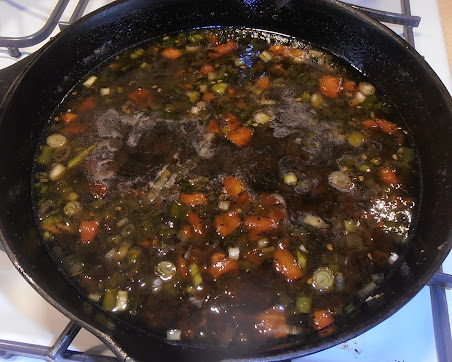
Melt the butter in a skillet, add green onions, tomato, and salt.  Saute it over medium-low heat until the tomato and onions are soft.  Don't let it get too dry.  

Add boiling water, raisins, pepper, and sugar to the skillet.  Simmer it about 20 minutes, stirring occasionally.

Preheat oven to 250 degrees F.  While it is heating, assemble the capirotada.

In a 13 x 9 inch casserole dish, pour enough of the sauce to cover the bottom, distributing the raisins and onions across the bottom.  

Here is the order of the layers that start on top of the syrup on the bottom:
Bread
Cheese
Eggs
Almonds

Repeat until the casserole is full, making the last layer just bread, syrup, and almonds.  

Heat it through in the oven.  Don't bake it, just get it hot.  Then broil it for a few minutes to make the top golden brown.
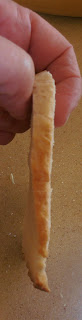
Very thin!
Golden brown
This is just 2/3 of the syrup.

My Notes

Originally I thought she intended me to use tomato paste, not fresh tomato, but a look around the 'net showed a few recipes that used fresh.

The tomatoes and onion mixture smelled so good while it was frying!  And I didn't let it get "too dry."

Originally I used 2 cups of water and 2 cups of sugar with the spices, but after assembling the capirotada, I felt it looked too dry.  I let it heat for 20 minutes and checked it - the bread was definitely too dry.  So I made another batch of syrup with just salt and pepper - no onions or tomato - and brushed some over the top layer of bread then poured the rest over all the layers.  Another 10 minutes later, I noticed the cheese was melted.

I actually started with 1 cup of sugar and then kept tasting until it seemed "very sweet."  I realized this gave made a basic simple syrup with a sugar-to-water ratio of 1 to 1.

It wasn't time to serve it, so I dropped the oven temperature to about 225 deg just to keep it warm.  At serving time, I broiled it for just a few minutes to brown the top.
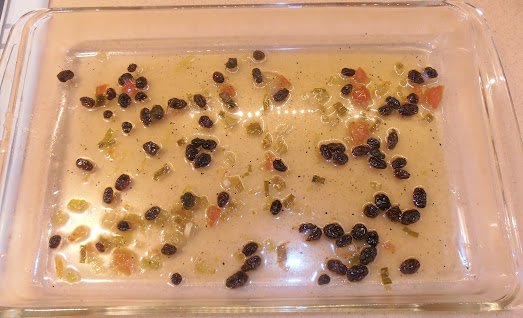
Distribute the veggies and fruit about the bottom of the casserole pan.
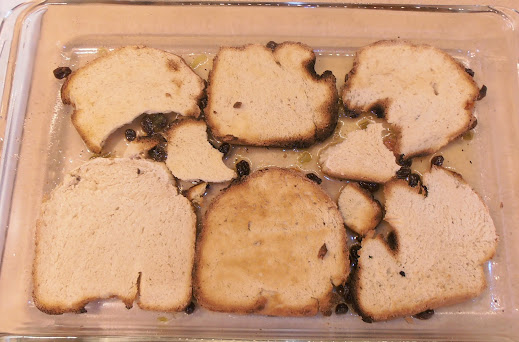
First bread layer.
All the layers except the top.
All done.  Maybe broil a little less so as not to scorch the nuts and raisins.
The Verdict

I had several friends as guest tasters - ones confident enough in my cooking that they requested me to experiment on them.  (!)  We had the capirotada along with a tossed green salad and baked chicken thighs.  (Notice that I had the thighs as a backup plan in the case no one liked the experiment; no one would go hungry.)


We liked it!  We found it intriguing to have the sweet syrup and syrup-soaked bread together with the cheese, eggs, raisins, onions, and almonds.  The pepper flavor came through but was not overwhelming, and made an interesting complement to the sweet syrup.  The cheese seemed to add body to each bite but did not, in itself, add much flavor.  Perhaps cotija cheese would be better?  

The almonds were a good idea as they added crunch to an otherwise soft dish.

The general consensus was that it was a good side dish - and it was nice to have the protein and non-sweet of the chicken to go with it.  (Whew!)

I was glad that I added more syrup to the mixture.  The bread was not dry, not even the top.  The lower layers of bread were very moist, and I liked that a lot.  

Layers!
Another guest taster tried it the next day and thought that it would make a very good brunch dish, because of the sweet bread (like French toast) and the eggs and onions (like an omelet).  

Success!

I tried the syrup before it all went onto the layers, and loved the mixture of sweet, onion, tomato (very faint, but there), and pepper.  The salt was not discernible, but it needed to be there and none of us felt like the dish needed more.

By the way, it was good hot from the oven and also warmed up as leftovers.

Monday, February 15, 2016

Cherry Bread Pudding with Vanilla Sauce

Company was coming for dinner and I wanted something different for dessert.  I also had a lot of several-days-old bread that needed to be used up before it went moldy.  My taste buds decided that a bread pudding would be just the thing!

My experience in eating bread pudding has primarily been from friends who took slightly stale bread, tore it up into chunks, piled them into a pan, soaked them with a custard of eggs, milk, sugar, and flavorings, and then baked them.  The key was a long soak so the bread chunks got damp all the way into the middle.

These were always good!

So I went looking for that sort of recipe and was amazed to find out that all the old recipes did not ask for bread chunks but for dried crumbs.

The recipe I chose was from Hearthside Cooking by Nancy Carter Crump.

ISBN 0-914440-94-2
This is a fun book because Ms. Crump took recipes "from a variety of primary 18th- and 19th-century sources both published and unpublished" from "archives, libraries, and private collections throughout Virginia and North Carolina."  Her goal for the book was to interpret those recipes both for modern kitchens and for fireplace, "hearthside", cooking.

While I was tempted to cook this on a hearth fire, I recognized that the time and effort involved were not compatible with the time I had allotted to prepare the dessert.  I'll save that for another day.

An Ordinary Bread Pudding (page 256)

Original recipe from the Virginia Gearhart Gray Collection:

Quarter of a pound of grated stale bread.  One quart of milk boiled with two or three sticks of cinnamon slightly broken.  Eight eggs Quarter of a pound of mace & little grated lemonpeel.  Two ounces butter.  Boil the milk with the cinnamon strain it and set it away till quite cold. Mix the butter and sugar.  Grate as much crumb of the bread as will weigh a quarter of a pound.  Beat the eggs and when the milk is cold stir them into it in turn with the bread and sugar.  Add the lemonpeel and if you choose a tablespoonful of rose-water.  Bake it in a buttered dish and grate nutmeg over it when done.  Do not send it to the table hot.  Baked puddings should never be eaten till they have become cold or at least cool.

Ms. Crump's redaction:

1 cup milk
1 cup cream
2 sticks cinnamon, broken in 3 or 4 pieces
2 teaspoons freshly grated lemon peel
1/4 cup melted butter
2 eggs, lightly beaten
1/2 cup sugar
1/4 teaspoon nutmeg
4 cups coarse bread crumbs
2 teaspoons rose water (optional)

1. Scald milk and cream with cinnamon sticks and lemon peel on trivet over hot coals.  Add butter and set aside to cool.  When cool, strain into eggs, combining well.

2. Add sugar and nutmeg to bread crumbs.  Pour in milk and egg mixture.  Add rose water, if desired, and stir mixture well.

3. Pour mixture into 1 1/2-quart buttered casserole in a preheated 350 degree F oven for 45 to 60 minutes "until knife inserted in middle comes out clean."

4.  Serve at room temperature or cold with cream, Vanilla Sauce, or Wine Sauce.


Cherries are in the bowl.
My Notes

I dried my bread crumbs in the oven just to make sure they were stale enough. They weren't crispy but stiff.

"Scalding" milk is not something I do often.  It requires heating the milk mixture gently until bubbles start forming around the edges of the pan.  What this does is allow the flavors of cinnamon and lemon to infuse the liquid.  I let it cool for a while on the counter to get that infusion but then got impatient and put the pan into the refrigerator.

Pre-scalding shot
I used rose water (love the stuff!) but only 1 teaspoon since I wasn't sure how my guests would react to it.  It was strong enough for me in the batter and subtle enough in the finished product for my guests.

Adding the custard to the crumbs
I wanted to use dried fruit to make it a little more "fancy" and happened to have some dried bing cherries handy. I covered them with boiling water for 15 minutes to soften them and then drained off the water. (Ms. Crump has a note at the end of the recipe:  "1/2 cup raisins or currants may be added."  My cherries measured out to about 3/4 cup after soaking.)

About half of the cherries went into the batter and were stirred in.  The other half I sprinkled on top of the batter just in case the first half decided to sink to the bottom of the pan.

Half the cherries here
Ready for the oven!
While the pudding was baking, I made the Vanilla Sauce.  I didn't use the recipe in Ms. Crump's book but a recipe I had copied from somewhere else and left as a note and a place marker at the bread pudding recipe.  Circa 1997.

Vanilla Sauce

1/2 cup sugar
1 Tablespoon cornstarch
1 cup boiling water
2 Tablespoons butter
1 teaspoon vanilla extract
dash salt


Mix sugar and cornstarch.  Add boiling water, stirring constantly.  Boil 5 minutes.  Remove from heat.  Stir in butter, vanilla, and salt.

My Notes

I followed this recipe as directed.  Boiling the mixture for 5 minutes made the sauce very thick. (Where were you when I needed you for the Lemon Cream Pie???)  I put the container of sauce into the refrigerator until it was time to serve it with the bread pudding.

You really do need to stir it constantly.
The Verdict

The baked pudding was beautiful.  We forgot to take a picture of the whole dish but here is one of what was left after serving.

The five of us ate nearly the whole thing!
It baked for the entire 60 minutes before a knife came out clean but I think it could have come out at 45 minutes and been a little moister.  Not a problem, though.

The texture was dense, moist, and the cherries made it a bit chewy.  The flavor was very slightly sweet.  It was hard to detect the spices and lemon but I think, as background flavors, they added depth.  The rosewater was very subtle and complimented the cherries well.

Everyone liked it.  The leftovers made a good breakfast treat.  I warmed them up and liked the flavor a lot.  I tasted more of the cinnamon.

Success!

The vanilla sauce was too solid coming right out of the refrigerator so I warmed it up in the microwave.  This caused it to bubble but it really didn't thin out to a pouring consistency.  Still, it was tasty with the pudding, adding more sweet and a vanilla counterpoint to the cherries and bread.  We just had to spread it around with a spoon.

So success with reservations.  Next time I won't refrigerate it in advance.

Pre-chilling consistency.  Perfect.
Reviewing this book reminded me how much I like to cook over fire and how I need more experience than what I get a few times a year at demonstrations.  Fortunately the weather has been cold enough to inspire me to build fires in the fireplace.  Perhaps I can get some cooking done there!

Monday, April 15, 2013

An Unusual Gold Rush Pudding

When I first read this recipe in From Fingers to Finger Bowls, A Sprightly History of California Cooking, by Helen Walker Linsenmeyer, I was immediately reminded of the dessert called "White Pot", a fine video of which is found at the YouTube channel of Jas Townsend and Son:  White Pot video.

A Copley Book, published by the Union-Tribune Publishing Co.

It is found in the chapter on the Gold Rush of 1849.  What impressed me is how the creator of this recipe managed to retain the good parts of White Pot while coping with the lack of an oven and probably reduced food supplies -- I can imagine someone making a taste of home while out in the wilds of Northern California.

The recipe is listed on page 75 simply as

Caramel Pudding

4 slices bread (lightly buttered)
2/3 cup brown sugar (firmly packed)
2 eggs, beaten with a fork
2 cups milk
1/2 teaspoon salt
1/2 teaspoon vanilla
1/4 cup raisins

Cut bread into small cubes and place in heavy saucepan.  Sprinkle sugar and raisins over the top.  Mix eggs and milk with salt and vanilla and pour over bread mixture.  Do not stir.  Cover and cook very slowly for an hour.

I was using a french bread loaf, which concerned me because I wondered if the four slices were smaller than what the author had intended.  But I went ahead and tried the recipe anyway!  I buttered the bread just on one side.

Everything was going into a small saucepan because it just didn't look like a large quantity.


After cutting the bread into cubes and sprinkling on the brown sugar and raisins, I mixed up the milk, eggs, salt, and vanilla, then poured it over the bread mixture.  Some of the bread cubes and raisins floated to the top.


The instructions said "cook very slowly for an hour" so I set my stove flame to the absolute lowest it offered, put the lid on the pan, and set the pan on the stove.  I decided I would trust in the recipe so I set the timer for one hour and walked away.  (This was hard!)

After about 40 minutes it really smelled good.  When the timer rang, I turned off the flame, took off the lid, and sniffed the pudding.  It was fabulous!


Perhaps I should have let it cool in the pan before turning it out but I couldn't wait.  When it inverted onto the serving plate, it sort of slumped all over.  Also, some of it stuck to the pan and I had to scrape it out.

Not attractive but still tasty

The Verdict:  I ate it while it was hot (not recommended as the raisins burned my mouth) and thought it was delicious.  Success!  I liked the caramel flavor and the creamy of the custard.  It was very delicate in texture.

The next day I tried the pudding straight out of the refrigerator and that, too, was tasty.  It was also firmer and the flavors had blended.  I liked it even more.

I had almost made it without the raisins just because I had to make a special trip to the store to get them.  I'm glad I didn't because I thought the raisins added a lovely texture (they are chewy and the pudding is soft) as well as a nice flavor.

It is a rich dessert so a little goes a long way.  I think you could easily serve this to four to six people and not feel like it was skimpy.

I think I probably could have put in another two slices of bread to thicken it and I would have buttered the bottom of the pan, too.  If you wanted to play with the recipe, you could add some spices, use whole wheat bread, change out the dried fruit, or reduce the sugar amount a little.

I heartily recommend this bread pudding-like dessert, especially because of the ease in cooking.  It would be good on a camping trip if I was cooking over coals.


Cookies Consent

This website uses cookies to offer you a better Browsing Experience. By using our website, You agree to the use of Cookies

Learn More