As much as you might proofread your own writing, it seems like errors can manage to sneak by. This is true even if you have other people reading your writing. And the longer the document, the more likely an error will occur.
This was as true in 1898 when Encarnación Pinedo published her cookbook, El Cocinero Español, as it is today. When I read through her book, I wasn't always sure if an error was hers (a writing error) or the printer's (a typesetting error).
In some cases, I guessed it was the printer's fault. For example, I came across "sicura" on page 73 and spent a long time trying to track down the meaning of that Spanish word. Well, it's not a Spanish word. But the word "cisura" is, and it means "opening." This worked well within the context of the recipe. This, I think, was made when the book was typeset (remember, no word processors or autocorrect back then!); they switched the c and the s.


On the other hand, on page 129, the second recipe for Stuffed Eggs has a very confusing direction. After the hard-boiled eggs are stuffed - like the ever-popular Deviled Eggs but with a more complex stuffing - a bird feather is supposed to brown the eggs.
A bird feather?
This is when I think she made a writing error. When you have about 880 recipes, this can happen.
Looking at the recipe as a whole, you recognize that the feather is the mistake, as evidenced by the instructions, "Put them in the dish when they have taken color" - that is, when they have browned.


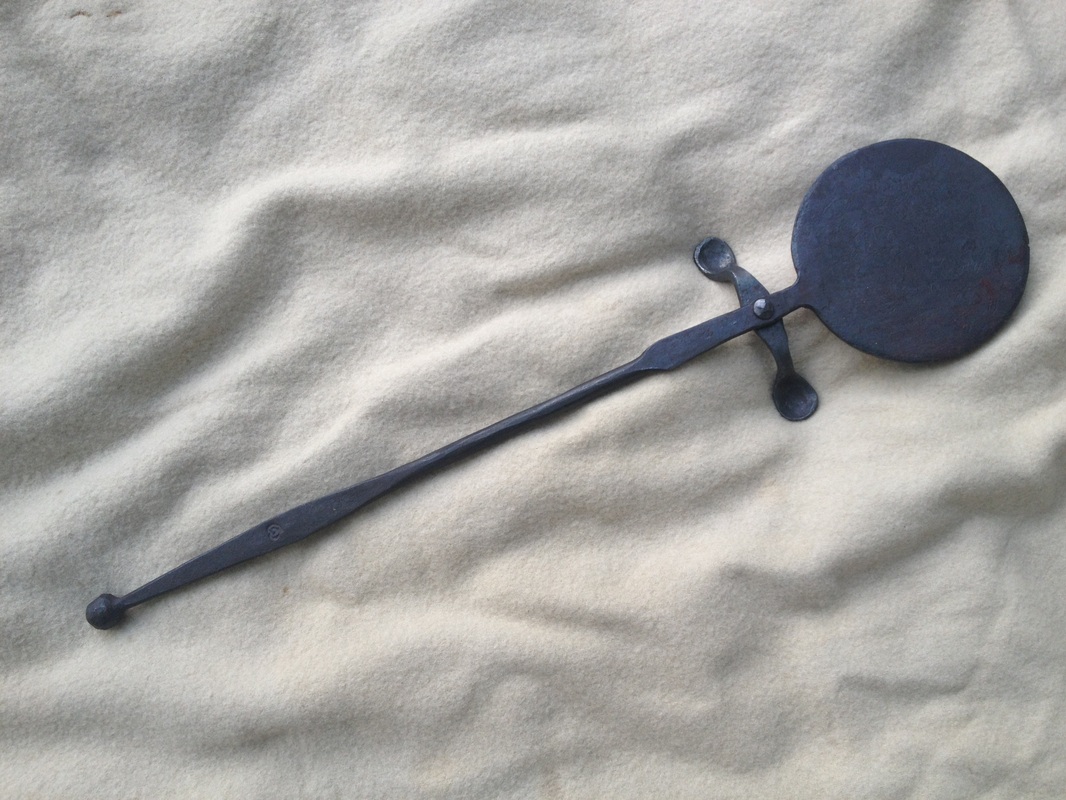
This is where a knowledge of Old Cooking comes in handy. In the days before ovens with broiler elements, one way to achieve the browning was using a salamander. It is a metal disk with a long handle. It is heated in the fire, then held over food. Its heat acts like a modern broiler, browning crumbs, melting cheese, and whatever else you need to have cooked from above.
Here's a picture:
 |
| http://www.fightingquakerforge.com/uploads/1/3/3/0/13300957/2845458_orig.jpg |
I hope to acquire one some day, just for the fun of showing it off and, of course, to use it in my historical cooking demonstrations.
Further investigation helped me feel more confident of my change, because I found a German recipe that is very similar to her recipe: Eier gefüllt und gebraten. Here, the stuffing is comprised of cooked yolks, with flavorings such as mustard and herbs, and is bound with soaked breadcrumbs and/or raw yolks, and then the filled eggs are fried stuffing-side-down or baked. Once that is done, shredded cheese is put on top and the eggs are broiled or oven-baked to melt the cheese. Some versions suggest making some sauce to put over the top.
I'm convinced Pinedo's recipe is a version of the German recipe, and no feather is needed to brown the stuffing.
There are more errors in her book, but nothing Earth-shattering. Items such as a simple misspelling, and instructions that appeared to be put in the wrong recipe. Most everything is well written.

No comments:
Post a Comment