This post begins my 14th year of food blogging. Sometimes I can't believe that is true! Researching, cooking, and writing up my experiences has become part of my regular routine: since I need to cook to eat, why not do something different for fun? When I review my posts and recall what I did and liked (and didn't like!), I get a sense of wonder at how many different types of food and cultures I have explored.
The conclusion of 2024 showed that this blog has 316 posts with over 188,000 page views from people from all over the world. I'm feeling rather proud of this.
My life and focus are turning harder to food history, especially California food history, although not exclusively so. My other blog, "The Spanish Cook Without Equal" found here: pinedo1898.blogspot.com, is growing along with this blog. In it I explore the recipes of Encarnación Pinedo's El Cocinero Español, published in 1898, which I translated. Those posts appear in both blogs, but the other blog is only her recipes. I hope you find time to peruse it, too.
Lately I have been reading and researching the history of the immigrants from Cornwall, England, to northern California around the time of the Gold Rush. The descendents from those immigrants still retain many of the "Cornish" eating habits, such as eating pasties (handpies with meat and potatoes) and celebrating special events with "revel buns", also known as saffron buns.
In 1998, Shirley Ewart with Harold T. George published The Cornish of Grass Valley California 1854 – 1954. They documented the memories of the early Cornish families of the region, and Ms. Ewart included some recipes from her grandmother, who ran a hotel in Cornwall for many years.
I chose to celebrate my 14th year of food blogging by making saffron "revel" buns using her grandmother's recipe on page 171.
Saffron Buns
1 package yeast (2 teaspoons)
1/4 cup warm water
1 cup milk
1/4 cup sugar
1 teaspoon salt
1/4 cup shortening
4 cups flours
3/4 cups currants
1/8 teaspoon saffron threads

Put 1/2 teaspoon sugar in lukewarm water. Add yeast. Stir and leave for 5 minutes.
Add the yeast to the milk.
Add 1 1/2 cups flour. Beat vigorously for 1 minute. Cover. Let rise in warm place until very light.
Add the rest of the flour and the fruit, kneading until the bowl is clean and you have a smooth ball of dough.
Put in a greased bowl. Grease the top of the dough. Cover with a clean towel. Let rise until double.
Make 24 smooth little balls. Set on greased cookie sheets. Cover and let stand about 15 minutes.
Bake 15 - 20 minutes at 375 degrees F.
My Notes
My reading showed that saffron buns might contain just currants, as specified in this recipe, or a mixture of currants, sultanas (golden raisins), raisins, and/or mixed candied citrus peel. I love golden raisins, so I used 3/4 cups fruit that was a pretty even mix of currants and sultanas.
Also, I doubled the amount of saffron to 1/4 teaspoon, as my reading also showed that amount could be up to 1 teaspoon. I wanted to make sure the saffron flavor would shine through.
It was amusing to watch the yeast and sugar water mixture proof for 5 minutes. I knew my yeast was active because it foamed up quickly!
 |
| Notice how much of the measuring spoon is covered. |
 |
| After five minutes. |
As typical in bread-making, I needed to add more water to make the dough come together in a moist (not dry) mass. Always be willing to adjust the water amount to make the dough work right.
The yeasted flour mixture became "very light" after an hour of rising. I poked it with my finger and found it was a fluffy mass.
 |
| Yeast mixture and some of the flour |
 |
| After 1 hour of rising. |
 |
| This is "very light." |
The completed dough rose for one hour to achieve doubling.
I got 22 little balls. It was challenging to figure out how to form them to have smooth tops with all the dried fruit in them. What I learned was that I stretched the dough to get a part that didn't have fruit in it, then fold that part to become the top surface. The rest of the dough (with fruit) was tucked in under it, and then the bottoms were pinched closed. I had to rework a few balls from the initial attempts once I figured it out.
I baked them for 18 minutes to make them golden brown.
 |
| Reasonably smooth balls. |
 |
| As golden brown as I could get them, without overbaking (I hoped). |
The Verdict
The buns were roughly two inches in diameter. A nice size so the consumer wasn't overwhelmed with a bread-eating committment.
The fruit amount was just right. I could get the taste of it in every bite, which was a nice blast of sweetness with the bread.
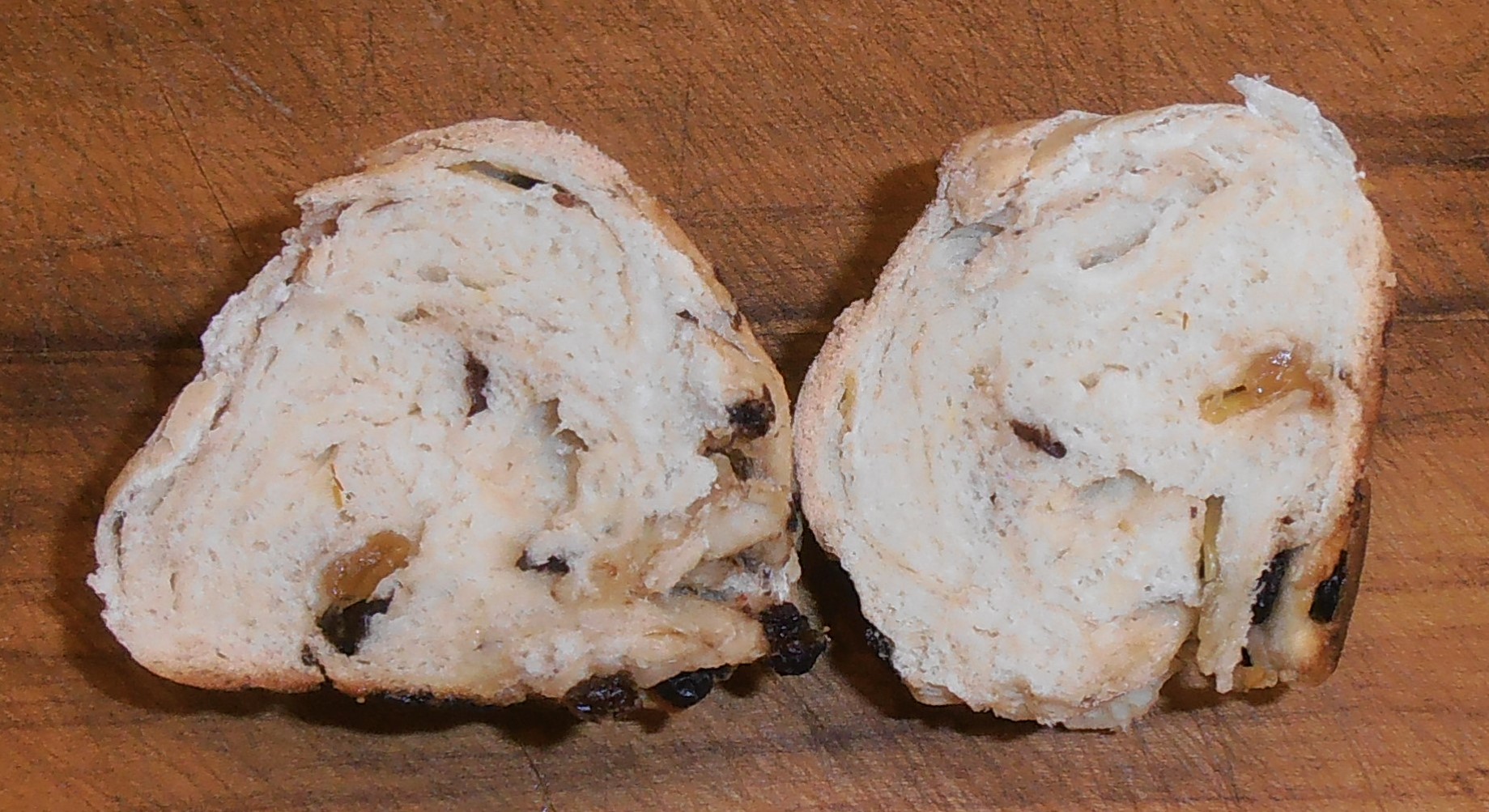
The saffron flavor was there and distinctive, but not overwhelming. It has been described as "earthy" and "astringent", and I agree with that. I expected "herbal" but that isn't a good description. It is a unique flavor, hard to put into words, but really good with the bread and fruit.
I expected the buns to be colored yellow from the saffron. They weren't yellow at all, which was disappointing. I suspect the technique of putting the saffron in the milk with the shortening was the culprit. The shortening melted and spread across the surface of the milk, engulfing the floating saffron threads. If the shortening was added after the saffron had time to infuse in the milk, I think I would have seen more yellow.
Some books suggest using yellow food coloring to boost the color, given that saffron is expensive. I didn't try that.
I took most of the buns to share at work, and the feedback was very positive. Most people had never tasted saffron before, but they liked it. The buns weren't too sweet, which many appreciated.
Success!
If I were to do this again, I would put some sort of glaze over the tops to make them shiny or browner.


