Showing posts with label beverage. Show all posts

Friday, July 5, 2019

Carob Molasses: Gulepp tal-harrub DONE RIGHT

Wow, did I make a big mistake.  It was just my good fortune and a bit of old training that kept me out of harm's way.

I previously wrote a post on Carob Molasses and found it was awful.  Extremely bitter.  I tasted a little and threw the rest away.  Then I contacted Dr. Albala, the author of the book with the recipe I tried, in order to figure out what was wrong.

Our discussion lead me to realize that I MISIDENTIFIED THE TREE.  Yes, what I thought was carob was not.  All my life that tree had been identified to me as carob.  I even looked through the internet to double-check.  But I was wrong.

The tree was actually Cassia leptophylla, the Gold Medallion Tree.  Parts are toxic!  I recalled that there is an evolutionary reason we taste bitter things, and that is to tell us when something is not good for us.  I am so glad I responded correctly to that, because it probably saved me a trip to the hospital.

It goes to show that eating plants can be hazardous, so always be careful!  I should have checked more thoroughly on the tree's identity before I tasted it.

Lesson learned.

Dr. Albala sent me some real carob pods.  This is what they look like, in comparison to what I had harvested.

One carob pod, about 4 inches long
Many carob pods
Gold Medallion Tree pods.  Toxic!
The carob pods are small and curved, whereas the other pods are long and straight.

I followed his instructions to make the syrup:

To make the syrup, just break up the pods, boil them for several hours in water and then strain.  Cook this down until thick, adding a little sugar to taste if you want.

Broken and ready for water
With water
Once the water was boiling, I turned the heat down to low to make it just simmer.  I had to add more water early on because I had barely covered them at the start.  They smelled slightly sweet while they were simmering.  I did cover the pan to cut down on evaporation.

After more than two hours of simmering, I strained them, then simmered to reduce it.
Strained
Reduced in the pan, for comparison.


The final quantity.


The Verdict

I tasted a pod after it was cooked and cooled.  It was soft and sweet and tasty!  I chewed it a little and got the almost-chocolate flavor.  I liked it.

I tasted the syrup after it cooled.  Well, it never got thick but I decided that it had reduced enough -- 1/4 cup!  I didn't want it to burn or evaporate all away.  But I will call it a syrup anyway.

It was still watery, not as concentrated as I think it should be.  But it was sweet with a deeper flavor that was something like chocolate and something like coffee.  I liked it!  Not bitter at all.  

Success!

The internet tells me that the syrup is used to flavor drinks, make a cough syrup, and to coat sore throats.  Some people make a liqueur out of it.  It is sometimes flavored with orange.

Thank you, Dr. Ken Albala, for your time, your help, and for sending me the right pods.  It was kind of you!

Saturday, June 1, 2019

Carob Molasses: Gulepp tal-harrub

UPDATE:  The pods you see in this post are NOT carob.  They are toxic and should not be used at all.  Please see my updated post for the correct pods.  Here is a link to the effects of ingesting this plant:  https://wagwalking.com/condition/golden-chain-tree-poisoning/

I recently acquired a copy of The Lost Arts of Hearth and Home -- The Happy Luddite's Guide to Domestic Self-Sufficiency, by Ken Albala and Rosanna Nafziger Henderson.  One reason it appealed to me was that the recipes were of very basic but interesting skills, exactly what the title promises:  lost arts, like unusual (to me) breads, making soy sauce, pickling fish, distilling and brewing, and even non-food skills like making soap, brooms, braided rugs, and your own exterior bread oven.

ISBN 978-0-399-53777-6

One recipe caught my eye, on page 43, called Carob Molasses.  Carobs are used as decorative features in my area -- they are pretty trees -- and I have always wondered what I could do with the pods.

Dr. Albala wrote up this particular recipe and I loved his description:
Carob is one of those health foods that suddenly appeared on the market when I was a kid, as a substitute for chocolate, which it isn't.  
This made me laugh, as that was exactly the experience I had as a kid!  I recall having it handed to me with a statement like, "This is made of carob, and tastes exactly like chocolate!"  No, no it doesn't.  Not even close.  I didn't know about being a foodie back then, but I knew carob's flavor was a poor imitation of chocolate and I wasn't going to accept it as an alternative.

But this recipe intrigued me.  It didn't promise to be like chocolate, just a long-valued syrup to be used in beverages or even (as he suggests) in barbecue sauce or chili.

Carob Molasses

To make the syrup, just break up the pods, boil them for several hours in water and then strain.  Cook this down until thick, adding a little sugar to taste if you want.

It was easy to gather an armful of pods off the ground around a convenient tree.

Easily two feet long or more
These pods are big!  I had to break them into fourths to fit them into my 6 liter Dutch oven.  I washed them first to get off dust and bugs.  The wash water turned light brown almost immediately.

Adding water to cover

I had originally thought the syrup would be made from the seeds, but it is the pods that contain the flavor.  The seeds are hard, and I tasted a piece of pod but really got nothing from it.


Wet pods gave off a slightly sweet scent.

I brought the water to a boil and reduced the heat to a rapid simmer and set the timer for 3 hours.  After about 30 minutes I decided to put the lid on to reduce evaporation, since I had already needed to add boiling water to keep all the pods covered.

I wasn't sure what would happen to the pods while cooking.  I imagined they would get pulpy or soft, but honestly, they remained hard.  You can see the water got very dark brown.

I removed all the pods and strained the liquid.  It measured 8 cups.


So I put it into another saucepan and brought the heat up so the liquid was steaming.  After another 2 1/2 hours, it had reduced to 2 cups.  Not thick but definitely thicker.


At this point, I decided to taste it.

The Verdict

It was pretty awful.

The dark brown, slightly thick liquid had only one flavor:  bitter.  No, let me restate that, it was BITTER.  Deep, concentrated, make-your-tongue-curl bitter.

The recipe suggested to add a little sugar but I realized that no amount of sugar would offset that intense bitterness.

Failure.

I must have done something wrong.  There is no way a concoction like this could be so loved and reproduced over the years.  I decided to contact Dr. Albala to get his opinion on my disaster.

He was kind enough to reply!  Our conversation led me to believe that either the pods were already bitter or that boiling them hard might have been the culprit.  Other online recipes suggest more soaking in hot water or simmering them very gently.

If I get the opportunity to get more pods, I will try it again.  I would really like to see what people enjoy about this food.

Sunday, May 19, 2019

Rose Shrub, a Springtime Treat

I have been hard-pressed to do my blog posts for the last two months.  No, work and life in general have not been the culprits; I can only point to my loquat tree in astonishment.

A loquat, in case you didn't know, is a semi-tropical fruit that happily grows in my area and I have a decent-sized tree on my property.  It has produced fruit before but this year, it outdid itself.  I have picked over 120 pounds of fruit so far and it looks like another 20 to 40 are still on it.  I have made loquat jam, loquat chutney, spiced loquats, and loquat liqueur.  I have 12 pounds cleaned and frozen, waiting for a break in my schedule.  I've given away many pounds to friends.  Loquats are lovely to eat fresh, so I've had a lot of that.

Here is a picture of my tree and a closeup of the fruit on the tree.

One heavily laden loquat tree
Luscious, heavenly, flavorful loquats
The fruit is sweet and tastes somewhat like peaches or apricots without the tartness.  But it is different from them, which makes it a treat.  The recipes are not historic and, although they are foodie fun, most of them I got off the Internet, so I didn't want to write them up for my blog.  Now you know!

But today's recipe has to do with another springtime treat:  Roses!

The wet winter and now cool, wet spring has my yard in full bloom and among the flowers are the roses I planted a few years ago.  Two are highly scented and one of those has been producing flowers regularly.  I decided I wanted to try something with the petals.

I turned to a book I used once before, when I made a Rosemary Tea Sherbert  (part 1 and part 2).  It is Flower Cookery -- The Art of Cooking with Flowers.

By Mary MacNicol, Fleet Press Corp, published 1967

Today's recipe is on page 164.

Rose Shrub

Take one and a half pounds of fresh rose petals, add three cups of water and boil up.  Remove from heat and when cool, strain.  Then add two and half pounds of sugar, and the beaten white of an egg, boil, skim, strain and bottle.


My Redaction

I picked all the rose petals I could off of the three rose bushes.  The dark red roses aren't scented but I wanted them for color.  The other two were deeply scented. 

The recipe books all say to remove the bitter white base of the rose petals.  I tasted them and found that only the red petals had a bitter base, which I tore off.  The other bases were sweet.

A beautiful basketful, picked on a rainy day
It filled my basket to the brim and yet the total weight was barely six ounces.  I needed to scale the proportions.

Rounding up to call it 6
1 1/2 pounds petals (by weight) to 3 cups of water (by volume) is the same as

24 ounces petals to 24 ounces water, so that scales down to 6 ounces of petals to 6 ounces of water.

Similarly, 2 1/2 pounds of sugar is 40 ounces (by weight), so

24 ounces petals to 40 ounces sugar gives

3 ounces petals to 5 ounces sugar.  I had 6 ounces petals so I used 10 ounces of sugar.


That is not a lot of water but the roses took up so much volume that I chose to use my enameled cast iron Dutch oven.  I put the water in the bottom and then packed the petals in on top.

A large pot filled with roses.
I liked that the lid was heavy as I wanted to keep as much of the water and rose scent in the container as possible.  I set the heat to medium high until the water boiled -- I saw steam coming out from under the lid.  Then I turned the heat down to low, which stopped the steam, but I could still hear it simmering.

After about 25 minutes, I turned the heat off and let the whole thing cool for a few hours.  At no time during the cooking and cooling process did I lift the lid.

Once it was cold, I looked inside.

Now they are cooked down.
I decided to squeeze the petals to extract all the liquid I could from them.  I scooped them into a small colander, placed that in the pan, and squeezed with my hands until no more liquid came out. 

Squished until they could offer no more.
You can see the lovely red liquid in the bottom of the pan.

Then I strained the liquid through a fine sieve into a measuring cup and saw it was almost 8 ounces.  I still decided to use the original 6 ounces of liquid quantity to determine the sugar amount because that is what the recipe seemed to indicate.

I put the liquid into a small saucepan and then I added the sugar and the entire amount of egg white, beaten.  I suppose I could have put in a lot less white but I chose not to.  I stirred it all together and put it over medium heat.
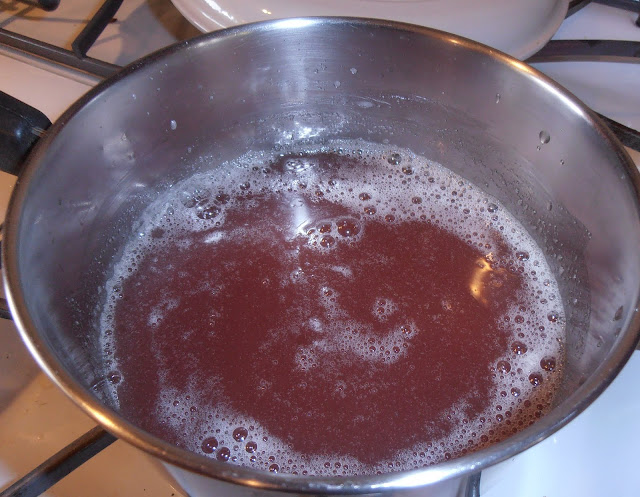
Just starting to warm up.
It started foaming almost immediately but I waited to skim it until it had come to a boil.  As it was heating I kept turning the temperature down so it wouldn't foam over.  When I saw bubbling along the edges, I used a small ladle to skim the foam off the top.

Foam!  You can see the boiling at this point, so I started skimming.
I kept skimming through the foam even though it seemed like I was taking a lot off.  Eventually I started seeing the clear syrup peeking through the foam.

Dark islands of syrup.
So I kept skimming, trying not to take the syrup off, until the surface was pretty clear.

Nearly done.
I used a wet paper towel to wipe the sides of the pan so that when I poured the syrup out, it wouldn't pick up more foam.  Then I poured the syrup through the fine mesh sieve into a clean jar.
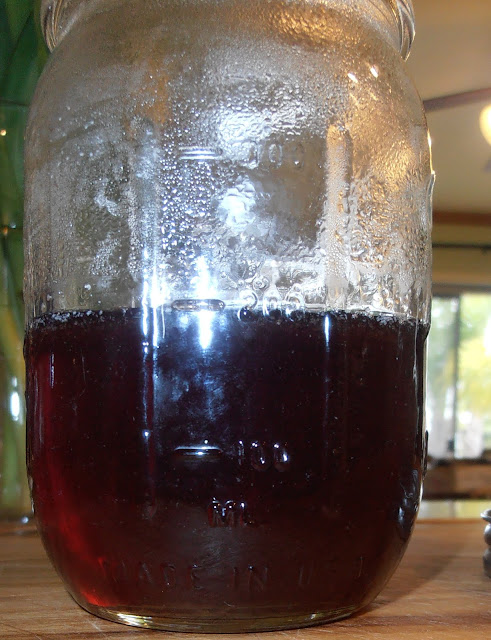
8 Ounces of Nectar!
After it cooled, I gave it the taste test.

The Verdict

First we tasted it just as it was, straight out of the jar.  It was definitely a sweet syrup, thick, with a lovely rose flavor.  One tester is a person who does not generally like the flavor of roses.  When she tried this, she liked it.  She felt the sugar gave the taste enough body to feel like she was drinking something, instead of just getting a strong scent of roses.  She also felt the rose flavor was an actual flavor and not just perfume.

Everyone liked it although we all agreed that it was too sweet to have more than just a sip or two.

So we tried it mixed with several other liquids.

Just adding cold water was okay but I think too much water was added; the ratio should be more like equal parts rose shrub and water but for me to say that, I will need to experiment more.

I also added equal parts tonic water, which was interesting because the tonic water is bubbly and has a bitter taste.  That shifted the whole experience away from sweet, which I liked, and the bitter added an extra dimension in flavor.  One taster, who does not like bitter, did not like the tonic water mix.

I mixed some of the shrub with a white wine, a little more wine than syrup.  That was intriguing because I no longer got the definite rose flavor but it didn't taste like wine, either.  It was a perfumed, fruity sensation that I truly liked.  One tester thought it could be described as a "rose sangria".  She does not normally like wine but felt this was a mixture she could drink, and she described it as "classy."  I liked that.

We also mixed it with white wine vinegar.  When it was about 2 parts shrub to 1 part vinegar, it was too tart for a beverage but we thought it would be a good sweet-and-sour glaze on roasted meat.  At about 3 parts syrup to 1 part vinegar, it was a refreshing, sippable beverage.  Actually, this is what I think of when I think about a beverage called shrub.

Success!

I want to make more (keeping blooming, my rose bushes!) and try it with other foods.  I think it would be good in lemonade, or drizzled over fresh loquats (or strawberries), or on pancakes, or in my hot chocolate, or mixed with vanilla yogurt as a fruit salad dressing, or brushed on the top of a cake hot from the oven (white, yellow, or lemon cake).

Tuesday, January 1, 2013

Harry Potter Fans! Buttered Beer!

Oh Wow.  A whole year of blogging has gone by as of today, January 1, 2013.  I am astonished that the site has had over 1200 page views.  I'm also pleased with myself at having maintained my personal goal of posting at least twice a month.

I've learned a few things over the year:  I should put more of myself into the writing, instead of making it a neutral report; many recipes from the past are simple to make and yet surprisingly flavorful; and eggs exposed to too much heat too quickly explode with a startling boom.

I've also learned how much fun it is to plan out the recipes, shop for them, document their production, and then share them with you.  I fully expect to continue this blog in 2013 and look forward to exploring the historical food of different eras and different cultures.

Now, on to the recipe.  One aspect I like of the Harry Potter series by J. K. Rowling is how the author did her homework -- Latin words really mean what the spell is doing and concepts from history are accurately utilized.  But what really put me over the top in my admiration for Ms. Rowling's writing was discovering this Elizabethan recipe for Buttered Beer.


To make Buttered Beere.
Take three pintes of Beere, put five yolkes of Egges to it, straine them together, and set it in a pewter pot to the fyre, and put to it halfe a pound of Sugar, one penniworth of Nutmegs beaten, one penniworth of Cloues beaten, and a halfepenniworth of Ginger beaten, and when it is all in, take another pewter pot and brewe them together, and set it to the fire againe, and when it is readie to boyle, take it from the fire, and put a dish of sweet butter into it, and brewe them together out of one pot into an other.

3 pints beer
5 egg yolks
½ lb sugar
nutmeg
cloves
ginger
butter (sweet)


Mix beer and egg yolks, strain into a pot. Put over the fire and add sugar and spices.
Stir well. Remove before it boils, add butter, stir, and reheat.

This one is made with oatmeal stout


My Notes:  Medieval eggs were smaller than ours, so either use small eggs or fewer large eggs.  Straining allows the chunks of yolk to be removed.  Do the spices to taste -- this means you get to taste the mixture a lot while creating it! -- mine ended up reminiscent of a good chai tea.

What you want to avoid is boiling the brew.  Just get it hot enough to dissolve the sugar, infuse the spices, and melt the butter.  Serve it warm as soon as possible to avoid the beer going completely flat.

The Verdict:  Success!  This is very good.  The beer is one of a variety of flavors and does not dominate.  The spices were enough to pique the tastebuds but not overwhelm.  The butter adds a lovely mouthfeel to make the whole experience rich and with depth.  I recommend it for a winter party beverage!


Cookies Consent

This website uses cookies to offer you a better Browsing Experience. By using our website, You agree to the use of Cookies

Learn More