Showing posts with label Henry VIII. Show all posts

Tuesday, May 1, 2012

Green Cheese

No, not Green Eggs and Ham, although I think I should make that for St. Patrick's Day some time.  This is a typical "farmer's cheese" made without rennet.  It is called "green" because it is unripened.  It is a lot like cottage cheese or ricotta.

It is as easy as can be to make and fun, too.  The ingredients are few:

1/2 gallon whole milk
1/4 - 1/2 cup white vinegar
salt is optional

First heat the milk in a pan over a low fire.


And I mean very low!


You want the milk to heat slowly so it doesn't skin over, or at least not too much.  Let it warm until small bubbles start forming at the edges and maybe a few in the middle.

Take it off the fire and gently stir in the vinegar.

The acid in the vinegar makes the milk solids separate from the liquids.  This is Little Miss Muffet's Curds and Whey!

Some curds already separating out.
I first put in 1/4 cup of vinegar.  After it had set for about 5 minutes, there were curds but the liquid was still very white.  That means you can get more curds out of it, so I added another 1/4 cup of vinegar.

Now it looks just like it should:  white curds and golden whey.

The curds are fully separated from the whey.
Let it sit for about 10 minutes or so to finish curding and to cool.

Next you line a strainer with cheese cloth or unbleached muslin.  Pour the mixture into it, so you keep the curds and discard the whey.


You can keep the whey if you'd like.  I'm sure there are some recipes out there for it, and I've heard you can use it as the primary liquid for bread, too, although I've never tried it.  There have been days where I was demonstrating cooking techniques while cooking over charcoal and sitting in the sun, and I found that the whey tastes very, very good then.   Try it; you may like it.  I've enjoyed it both warm and cold.

The recipe I first learned from suggests you squeeze the curds to press out the whey but I found this tends to push the curds through the cheesecloth.  So I just let it drain for about an hour.  That seems to work well.

Once it is done you have moist but not soggy curds that smell like fresh milk.


You can mix in a little salt to flavor it and to help preserve it.  You can also mix in a variety of things:  herbs, chopped fruit, spices, or even a little cream to smooth out the texture.  Before you put in the cream, though, work the curds thoroughly with a fork to break them up into smaller pieces.  You may like that texture better and don't need the cream.

Keep in mind that you only get about 1 - 2 cups of curds from 1/2 gallon of milk.  That tells me why cheese is so expensive!

The Verdict:  Success, as always!  This recipe has never failed me.  It is fun, easy, and makes a tasty result.

This is an old, old recipe.  People have made cheese like this for centuries.  You are limited only by your imagination in what you can do with it.  Make lasagna or a sweet spread for bread or something to put between cake layers or...

I'll leave it to you!

Thursday, March 15, 2012

Tudor Kitchen, Part 3

As I mentioned in Part 1, in 2007 I was fortunate enough to visit London, England.  The number one item on my "to do" list was to visit the Hampton Court Palace, which Henry VIII used as one of his palaces.  It has a working Tudor kitchen and I want to share what I saw with you.

This part focuses on food and storage.

Here is some beef that was roasted on the spit.  Notice the hole!


And here are some pies before they are baked...


... and afterwards!  Pies were their own container and didn't need any special cooking dish.  This was convenient when cooking for crowds.


Serving implements include metal plates if you can afford them; wooden if you can't.  Trenchers, plates made from sliced, stale bread, are out of fashion at this time.


 Most people ate with spoons and knives.  Forks were not considered eating utensils in England.  The spoon shapes you see here are typical of the period.


Storage containers came in a variety of shapes and materials, depending on usage.

These are various containers:  tall storage jars with lids (unglazed because they didn't need to be), two pitchers, and some bowls.


These are pitchers and jugs.  The green glaze is a typical color popular in the Henrian era.


You can take cloths and tie them over the tops of the containers, especially if the containers have a lipped edge to catch the string.  I have also heard that sometimes the cloth was oiled or waxed.  I think that would be considered expensive in this time period.


These storage pots are only partially glazed, as was typical of the era.


These beautiful red ware bowls are only glazed on the inside.  Good for mixing, serving, and storing.


I believe this is a salt cellar.  Salt was considered a spice, was often mentioned as a "sauce" to be served with meats, and was expensive, though not as expensive as pepper and other imported spices.  The container could be something else, though, since it wasn't labeled.


So there you have it.  A brief tour though the Tudor Kitchens at Hampton Court Palace.  I hope you go there some day and witness an actual cooking event.  They do demonstrations with experts who are in costume and probably in character.  I want to hear about your adventure!


Thursday, March 8, 2012

Tudor Kitchen, Part 2

As I mentioned in Part 1, in 2007 I was fortunate enough to visit London, England.  The number one item on my "to do" list was to visit the Hampton Court Palace, which Henry VIII used as one of his palaces.  It has a working Tudor kitchen and I want to share what I saw with you.

This part focuses on food preparation tools.

This turns a spit automatically, so some poor soul doesn't have to sit there for hours doing it by hand.


These tools allow you to suspend a pot over the fire and adjust its height.


A chunk of tree trunk serves as a chopping block for meat.


A grinder for sharpening knives.


This looks like a handy, stable bowl for chopping things like herbs.  I have a similar one that is smaller and came with a blade that was curved to fit (an Alaskan ulu knife).  I don't know if this had a curved blade with it or not.  I know that having a bowl for chopping makes the work easy and efficient.


Compare it to this mortar, which is about 10 inches in diameter and set into a counter.  Wow!


 This grater looks like it will do a good job!

 
 These are pipkins (ceramic first, metal below).  They are small, footed saucepans or cooking vessels.  The feet keep them stable and raised above a bed of coals, allowing air to circulate to help the coals stay hot.  Notice the glazing, which is not uniform over the container.  Glazing was expensive although it does seal the pot and makes it easier to clean.


This is a fry pan sitting on a stand.  Since the pan doesn't have feet, the stand raises it and stabilizes it.  Behind the pan is another pipkin.  The hole in the handle allows it to stay cool over the fire.  Some people say you can put a wooden stick in there to help move it but I would be concerned it would break the handle.

These are a grate and a drip pan.  The grate helps you cook directly over the coals, like a piece of fish you want to cook quickly.  The drip pan catches the juices of the meat as it cooks so you can baste with it or make a gravy.  **This could be a griddle instead!  Or it might play both parts.

 
 This stand can be used with a variety of pots or pans to raise them above the coals.  If a fry pan comes with its own legs, it is called a "spider". 

I noticed that this kitchen had a lot of brick counters on which the food was cooked, instead of a lot of little fire pits scattered around the room.  The counter had small openings with bars. This put the cooking surface at a comfortable height and allowed the cook to better control the fire's overall temperature.  I think you would bring over coals from a main fire, place them in the pit and put the pots over it for cooking.

These tools help you manipulate the fire.  I have similar ones (it helps to have friends who are blacksmiths!) so I would use the forked object to find live coals buried in mounds of ash. 


Some food was cooked in copper bowls set into the counter top with a fire built below it.


 The available techniques were varied, not primitive at all.  Food was baked, boiled, broiled, roasted, grilled, fried, and stewed.  The temperatures for cooking were controlled well.  This kitchen appears to be efficient and quite useful!

Part 3, "Food and Storage" will arrive next.


Thursday, March 1, 2012

Tudor Kitchen, Part 1

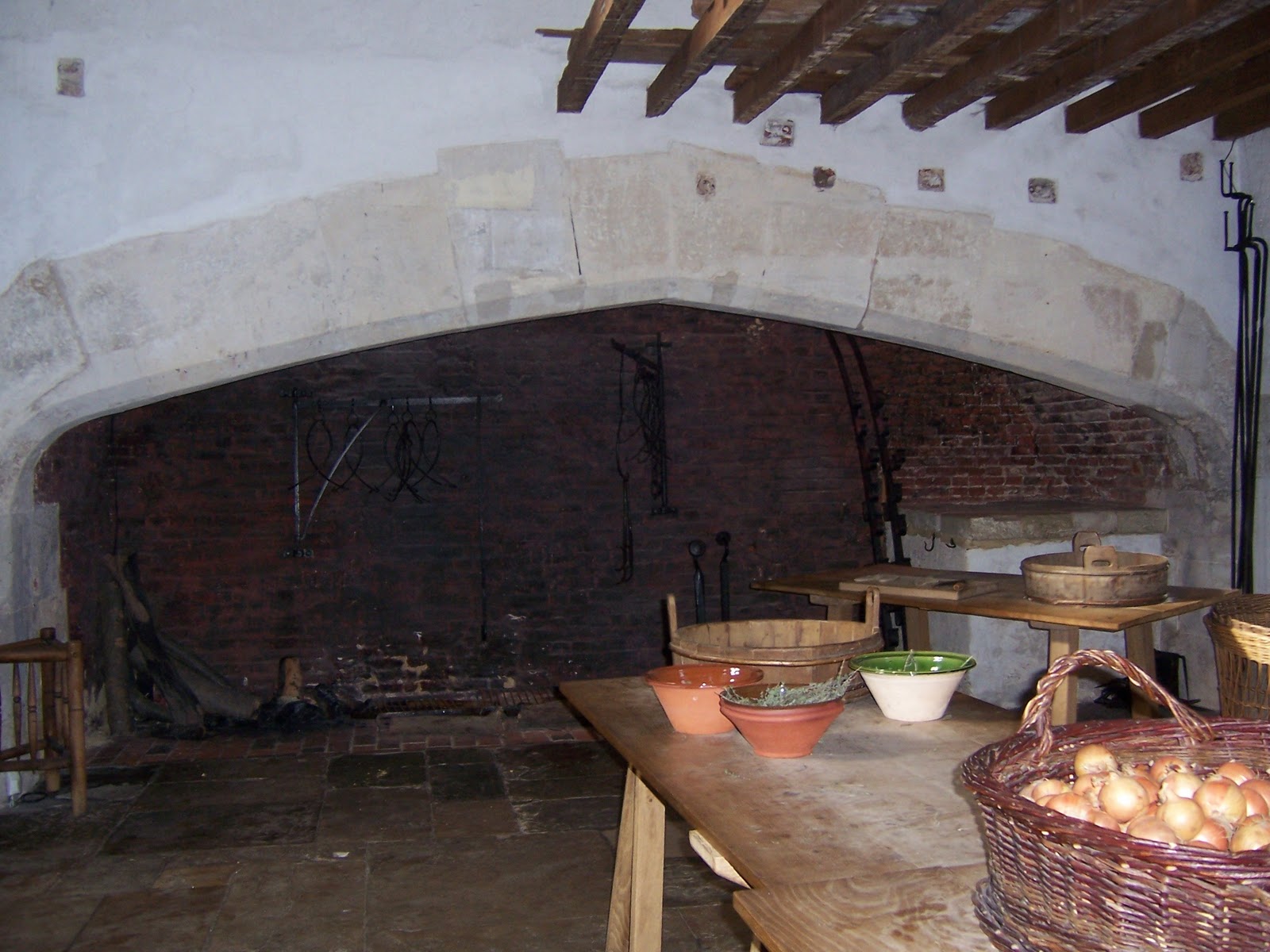
In 2007 I was fortunate enough to visit London, England.  The number one item on my "to do" list was to visit the Hampton Court Palace, which Henry VIII used as one of his palaces.  It has a working Tudor kitchen and I was determined to see it.  Of course I went nuts and took about 100 pictures of items that would really only appeal to cooks...

I am interested in how kitchens, equipment, and some food items looked from this time period and I want to share what I saw with you.  This tour comes in parts for brevity and organization.  Let's start with the kitchen.  **Remember, this is a royal kitchen, designed to make and serve food for hundreds of people each day.  This is not your average, ordinary home-style kitchen.  Men were the cooks and everything was, well, "king-sized".

This is just one room where preparations were made.


Another room with another table.


One fireplace, big enough to cook a very large animal!


Another fireplace, designed with spits to roast large chunks of meat.


The ovens were smaller.  This allows them to hold the heat close to the items being baked.


 This is a small storage room with barrels and baskets.  Look at the fish!


This gives you just a glimpse of what the place was really like.  They do cooking demos here and of course let the public wander through.  From what I have read, when this was a working kitchen, the place would be packed with people and tables and supplies all trying to coordinate meals fit for a king and his court.

Part 2:  "Food Prep Tools", to follow.

Cookies Consent

This website uses cookies to offer you a better Browsing Experience. By using our website, You agree to the use of Cookies

Learn More